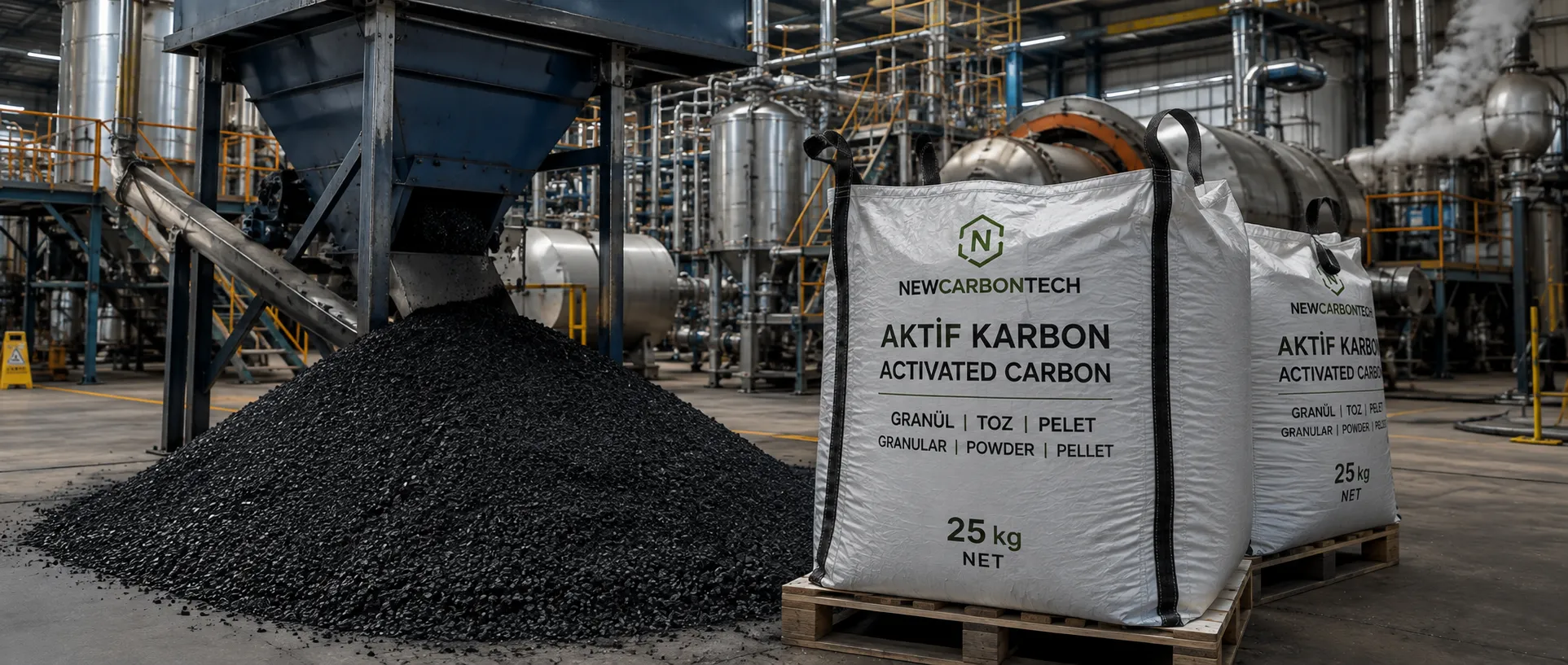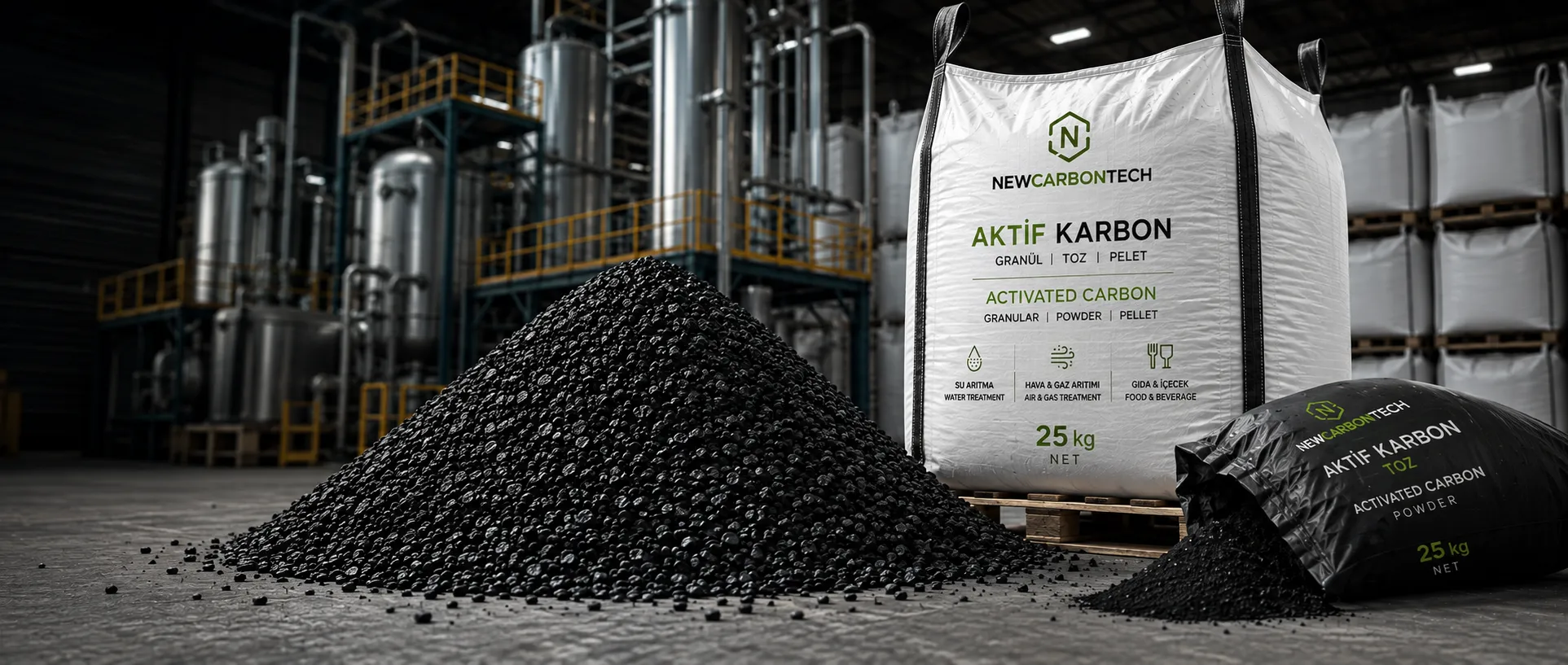
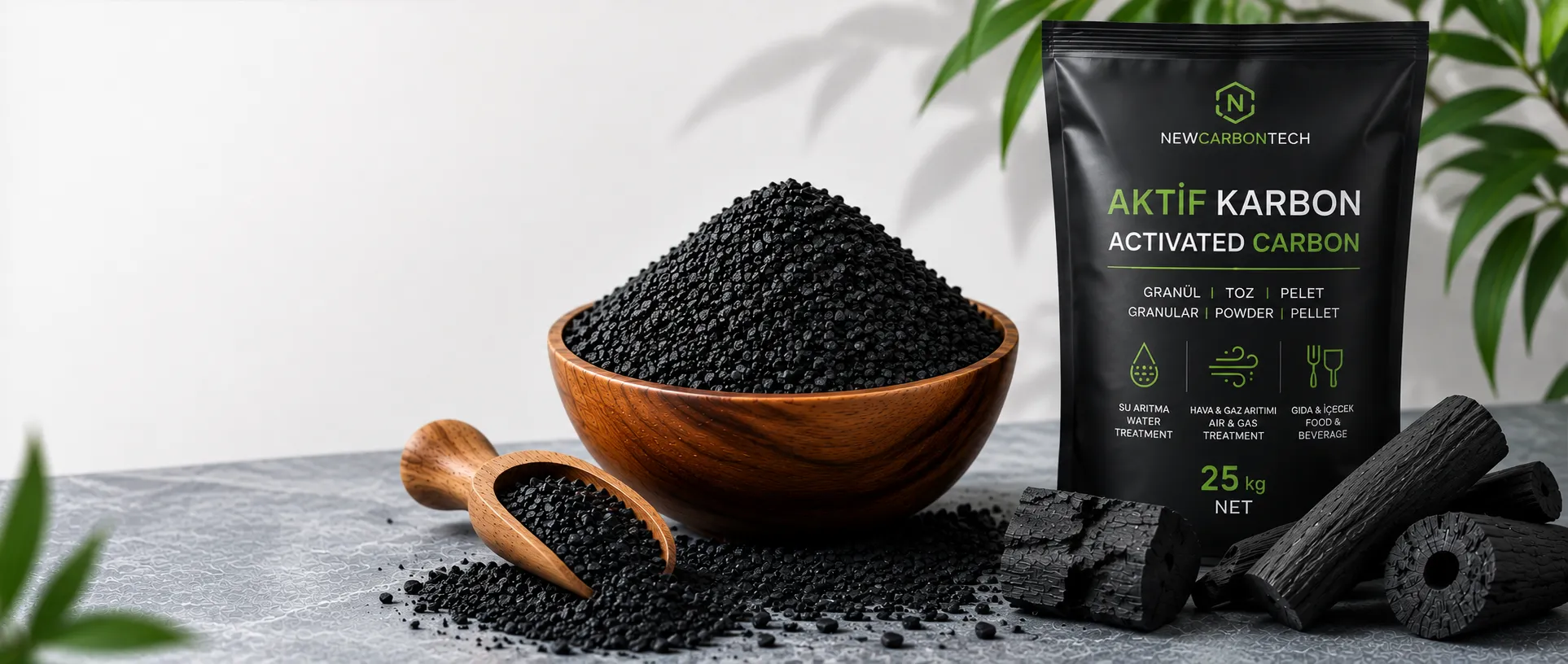
A thousand square meters in a single gram.
NewCarbonTech produces granular, powdered and pelletized activated carbon for water, air and process treatment. The entire chain runs in our own facility, under our own control.
- 1000+ m²/g
- BET surface area
- 6 categories · 15 products
- GAC · PAC · Pellet · Impregnated · Hard Carbon
- 100%
- Made in Türkiye
Why NewCarbonTech?
We take carbon in raw,
we deliver it as a solution.
Activated carbon is not a commodity — it is an engineered product. If pore distribution, hardness and mesh range are not tuned to your application, your filter clogs early and your process gets expensive.
- Application-specific productionIodine number, CTC and hardness targets are tuned to your process — not picked from a catalog.
- Our own activation lineEvery step including steam activation under one roof — no middle suppliers, full batch traceability.
- Lab-approved shipmentNo batch leaves the plant without passing iodine, methylene blue, moisture and ash analyses.
- Continuous supplyStocked operation and planned production keep carbon flowing to your treatment plants without interruption.
Product Families
Every pore has a job to do
Granular Activated Carbon
Screened, high-hardness granular carbons for fixed-bed filters. Produced with a narrow mesh distribution for low pressure drop and long service life.
- Coal-Based Granular Carbon
- Coconut Shell Granular Carbon
- Gold Recovery Carbon (CIL/CIP)
Powdered Activated Carbon
Finely ground, fast-adsorbing carbons applied by dosing. The standard for batch decolorization and purification processes.
- Wood-Based Powdered Carbon
- Coal-Based Powdered Carbon
Pelletized Activated Carbon
Extruded carbons for air and gas phase applications. Low pressure drop, low dust release, high CTC activity.
- Pellet Carbon 3 mm
- Pellet Carbon 4 mm
Impregnated Activated Carbon
Carbons chemically loaded for the target contaminant: where adsorption is not enough, chemisorption takes over.
- Sulfur-Impregnated Carbon
- KOH-Impregnated Carbon
- KI-Impregnated Carbon
- Silver-Impregnated Carbon
Hard Carbon
Non-graphitizable, disordered carbon: the anode material of sodium-ion batteries. Battery-grade purity from coconut shell feedstock.
- Battery-Grade Hard Carbon
- Hard Carbon Precursor
Catalytic & Specialty Carbons
Surface-modified specialty carbons without impregnation, plus niche application products.
- Catalytic Carbon
- Acid-Washed Low-Ash Carbon
Applications
Clean water, clean air, clean process
Water Treatment
Removal of organics, chlorine and odor in drinking, waste and process water.
Air & Gas
VOC capture, flue gas treatment and odor control in cabin filters.
Food & Beverage
Decolorization of sugar, oils and beverages; quality and clarity.
Mining
High-hardness granular carbon for CIP/CIL gold recovery circuits.
Pharma & Chemicals
Purification, catalyst support and powdered carbon for API processes.
Energy & Battery
Hard carbon for sodium-ion battery anodes; solvent recovery and biogas upgrading.
Production Process
Character earned at 900°C
Raw Material Selection
Coconut shell, coal and wood-based feedstocks selected and prepared for the application.
Carbonization
Heat treatment in a controlled atmosphere: volatiles are driven off, the carbon skeleton forms.
Steam Activation
Activation with steam above 900°C: a pore surface exceeding 1000 m² per gram is created.
Screening & Quality
Classification by mesh range; shipment approval with iodine, hardness and ash analyses.
FAQ
Frequently asked questions
What is activated carbon and how does it work?
Activated carbon is carbon that has been steam-activated to gain a pore surface exceeding 1000 m² per gram. Contaminants attach to this surface by adsorption; it is the core material of water, air and gas treatment.
What is the difference between granular (GAC) and powdered (PAC) carbon?
Granular carbon works in fixed-bed filters under continuous flow and can be reactivated; powdered carbon is dosed into the process and acts fast. Choose GAC for continuous lines, PAC for batch color and odor problems.
Which activated carbon suits which application?
Granular for water treatment, powdered for decolorization, pellets for air and gas lines; impregnated carbon for special contaminants such as mercury and H₂S. The right choice depends on iodine number, mesh range and pore distribution.
When should activated carbon be replaced?
When contaminant breakthrough appears in the outlet, or when the iodine number drops significantly. Typical service life is 6–24 months depending on the application; granular carbon can be reused through reactivation.
Is hard carbon the same as activated carbon?
No. Hard carbon is a non-graphitizable carbon used as the anode material in sodium-ion batteries; it is not an adsorbent. It does share its feedstock with activated carbon: coconut shell.