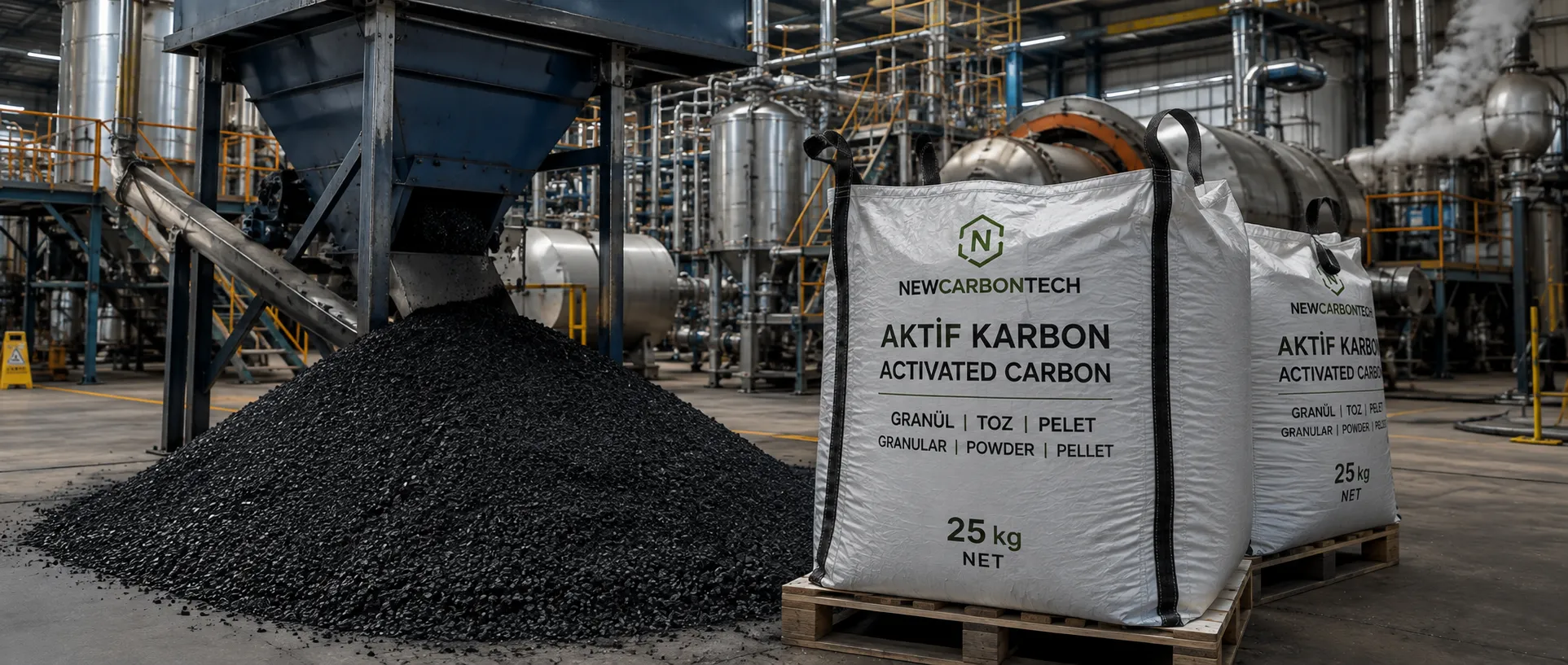
Powdered Activated Carbon (PAC)
Powdered activated carbon (PAC) is carbon ground so that ninety percent of particles fall below 45 microns, applied by dosing. Its huge external surface completes adsorption within minutes; it is the first choice of batch processes and seasonal contamination events.
Our wood-based powders specialize in decolorization, our coal-based powders in wastewater and flue gas dosing. A food-contact production option is available; every batch ships with methylene blue and iodine analysis.
When to Choose It
- Color, taste or odor problems arrive seasonally
- You produce in batches
- You want to deploy fast without filter investment
- You need dose flexibility against variable contaminant loads
Technical Specifications
| Parameter | Typical Value | Test Standard |
|---|---|---|
| Particle size | 90% < 45 µm | ASTM D5158 |
| Methylene blue | 180–240 ml/g | CEFIC |
| Iodine number | 800–1000 mg/g | ASTM D4607 |
| Moisture (as packed) | max 8% | ASTM D2867 |
| Total ash | max 10% | ASTM D2866 |
| Packaging | 25 kg bags / big-bag | — |
Values are typical production ranges; a batch analysis certificate ships with every order.
Applications
- Sugar and glucose syrup decolorization
- Beverage and juice clarification
- Vegetable oil refining
- Seasonal taste and odor (geosmin/MIB) control in drinking water
- Organic load dosing in wastewater
- Dioxin-furan capture in flue gas
Three golden rules of dosing
- Determine the dose by jar test; every water and product behaves differently — there is no catalog dose.
- Feed the carbon as slurry; dry powder dosing never distributes evenly.
- Allow 15–45 minutes of contact; early filtration throws capacity away.
Frequently Asked Questions
Does PAC dissolve in water?
No. Powdered carbon is insoluble; it works as a suspension and is separated from the product at the end of the process by filtration or settling.
Is it suitable for food applications?
Yes — food-contact grades are available for sugar, beverage and oil refining, supplied with batch analysis certificates.
What is a typical dosage?
5–25 mg/L in drinking water; in product decolorization it can rise to kilograms per ton. The exact dose comes from a jar test — we support you with the test protocol.