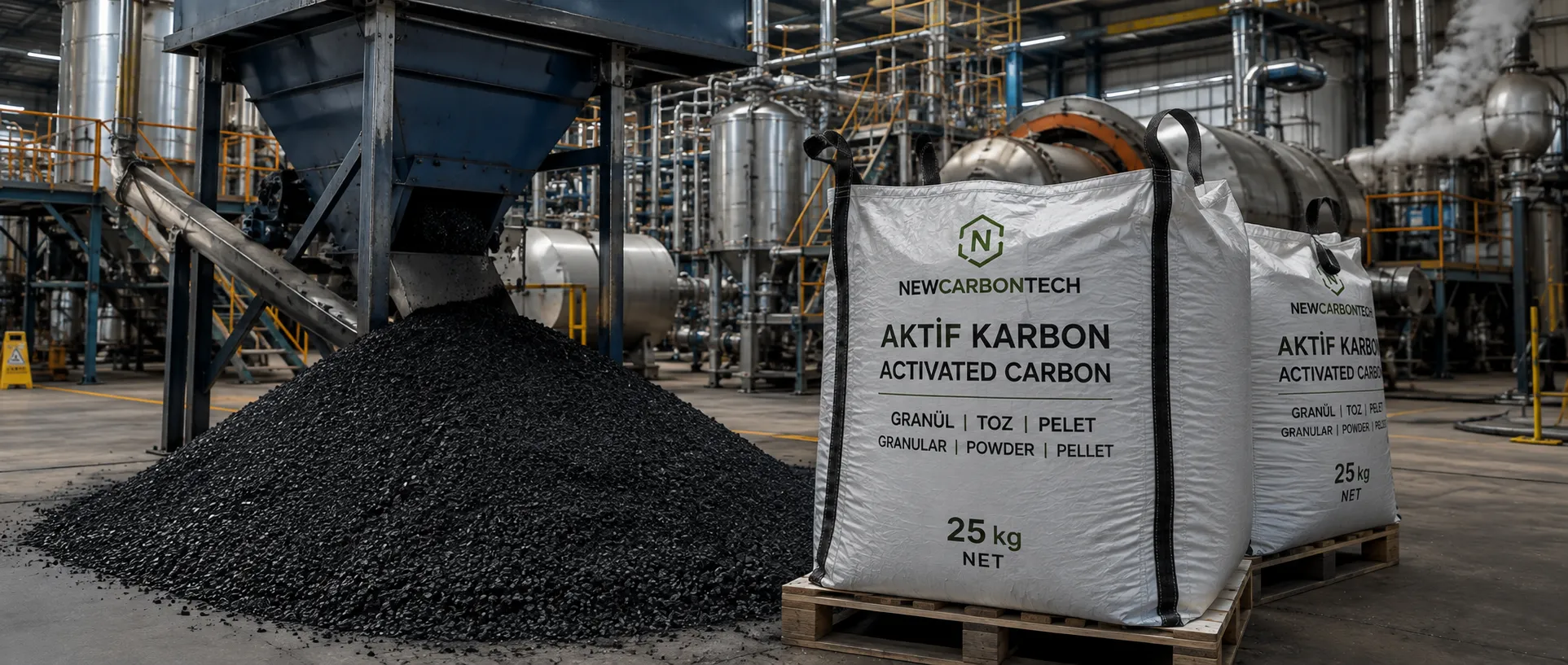
Impregnated Activated Carbon
Impregnated activated carbon carries a reactive chemical pre-loaded onto its pore surface, matched to a target contaminant. Molecules that standard carbon cannot hold — mercury, H2S, ammonia — react on the impregnated surface, convert into stable compounds and bind permanently.
We produce four main types: sulfur for mercury removal, KOH for acid gases and odor, KI for biogas and refinery lines, and silver for bacteriostatic protection in drinking water filters.
When to Choose It
- You face a targeted contaminant such as mercury vapor, H2S or mercaptans
- Small, volatile molecules slip through your standard carbon
- You must meet an emission limit with chemical certainty
- You need microbiological protection in water filter manufacturing
Technical Specifications
| Parameter | Typical Value | Test Standard |
|---|---|---|
| Sulfur loading | 10–15% (mercury grade) | — |
| H2S capacity | 0.14+ g/cc (KOH grade) | ASTM D6646 |
| Silver loading | 0.05–0.1% (Ag grade) | — |
| Carrier form | Granular or 4 mm pellet | — |
| Carrier iodine number | 950–1100 mg/g | ASTM D4607 |
| Hardness | min 95% | ASTM D3802 |
Values are typical production ranges; a batch analysis certificate ships with every order.
Applications
- Mercury capture in natural gas and LNG lines
- Odor control at treatment plants and pump stations
- H2S and organic sulfur cleanup from biogas
- Refinery and petrochemical gas streams
- Flue gas emission compliance
- Household and POU water filter cartridges (silver)
Three rules of impregnated bed operation
- Chemisorption is irreversible; monitor the outlet and plan changeout with a safety margin.
- Run two beds in series on critical lines; the second bed is your safety barrier.
- Respect the temperature and humidity window; heat drives off the impregnant, condensation drowns the pores.
Frequently Asked Questions
Can impregnated carbon be regenerated?
No. Chemisorption products stay in the pores permanently; a spent bed is replaced. Carbons loaded with hazardous contaminants such as mercury are disposed of under the relevant regulations.
Which impregnation type should I choose?
By target contaminant: sulfur for mercury, KOH for H2S and odor, KI for long life in biogas, silver for in-filter bacterial control. Share your gas composition and we will pin it down together.
What is the lead time?
Standard grades run from stock; custom loading ratios are produced to order. Contact us for current schedules.