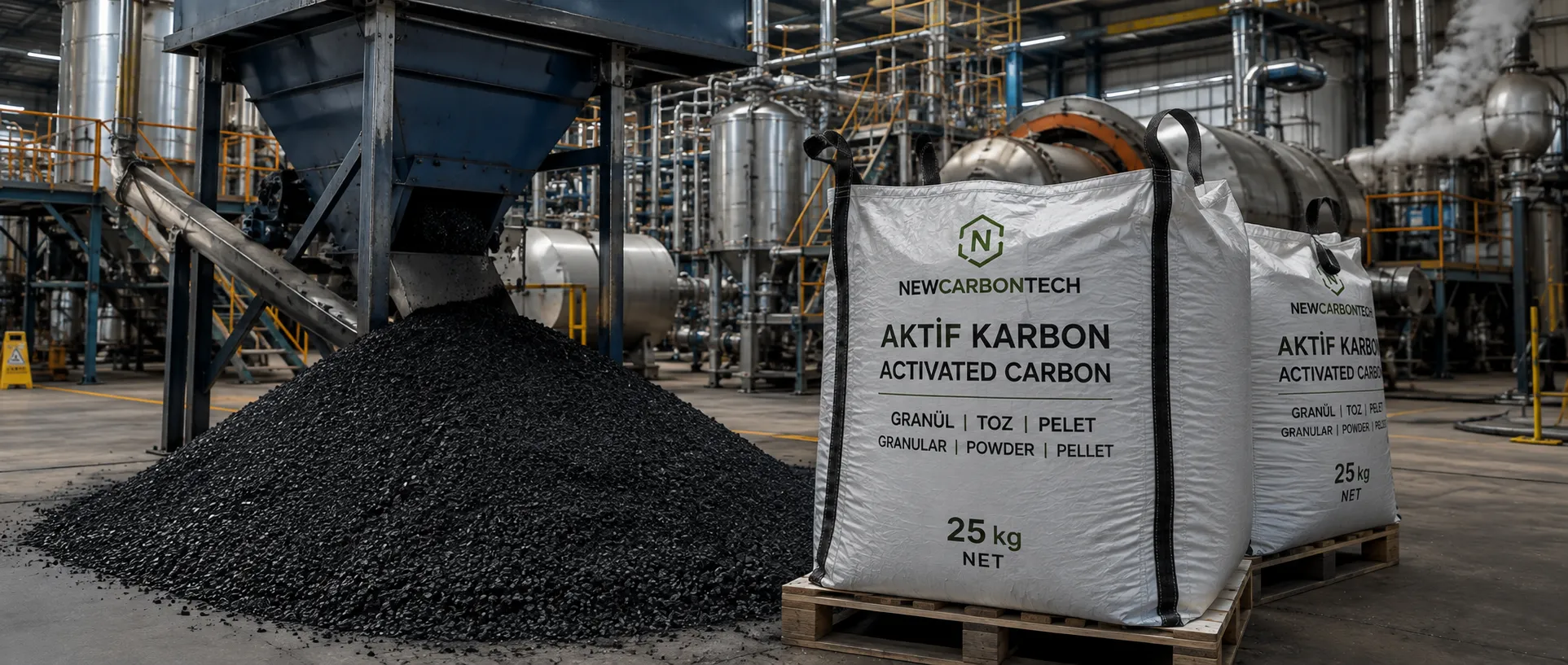
Granular Activated Carbon (GAC)
Granular activated carbon (GAC) is the standard fill of fixed-bed filter systems. Its screened, irregular particles allow continuous flow at low pressure drop while capturing contaminants in their pores. Because it can be renewed by thermal reactivation once saturated, it is the most economical carbon form for high-volume operations.
NewCarbonTech granular carbons are produced from coal and coconut shell feedstocks; steam activation and mesh screening happen in our own facility. Every batch ships documented with iodine number, hardness, moisture and ash analyses.
When to Choose It
- You run a continuous-flow line with a relatively stable contaminant load
- A filter column is installed or planned
- You target long-term cost advantage through reactivation
- You operate drinking water, process water or a gold recovery circuit
Technical Specifications
| Parameter | Typical Value | Test Standard |
|---|---|---|
| Mesh range | 6x12 / 8x30 / 12x40 | ASTM D2862 |
| Iodine number | 900–1150 mg/g | ASTM D4607 |
| Hardness | min 95% (gold grade 97%+) | ASTM D3802 |
| Moisture (as packed) | max 5% | ASTM D2867 |
| Total ash | max 12% (acid washed: 3%) | ASTM D2866 |
| Bulk density | 450–520 kg/m³ | ASTM D2854 |
Values are typical production ranges; a batch analysis certificate ships with every order.
Applications
- Municipal and industrial drinking water treatment
- Process water and RO membrane protection (dechlorination)
- Gold recovery — CIL/CIP circuits
- Tertiary wastewater polishing
- Aquarium and pool filtration
- Bottled water production lines
Three practical rules of bed design
- Keep empty bed contact time (EBCT) within 5–15 minutes; short contact wastes capacity.
- In backwashed systems match mesh size to wash velocity; fine grains escape during backwash.
- Change the bed at breakthrough onset, not full exhaustion — reactivation yield improves too.
Frequently Asked Questions
How long does granular activated carbon last?
Typically 6–24 months depending on the application. Rising target parameters at the outlet, or an iodine number down to 50-60% of new carbon, signal changeout. Granular carbon can be reused through reactivation.
Which mesh size should I choose?
8x30 is the industry standard for municipal treatment, 12x40 for drinking water polishing, 6x12 for gold circuits. We can finalize together based on your flow, bed depth and pressure drop tolerance.
Coal based or coconut based?
Coal based is economical and balanced for general water treatment; coconut takes the lead in drinking water, volatile organics and gold recovery thanks to its microporous, hard structure.