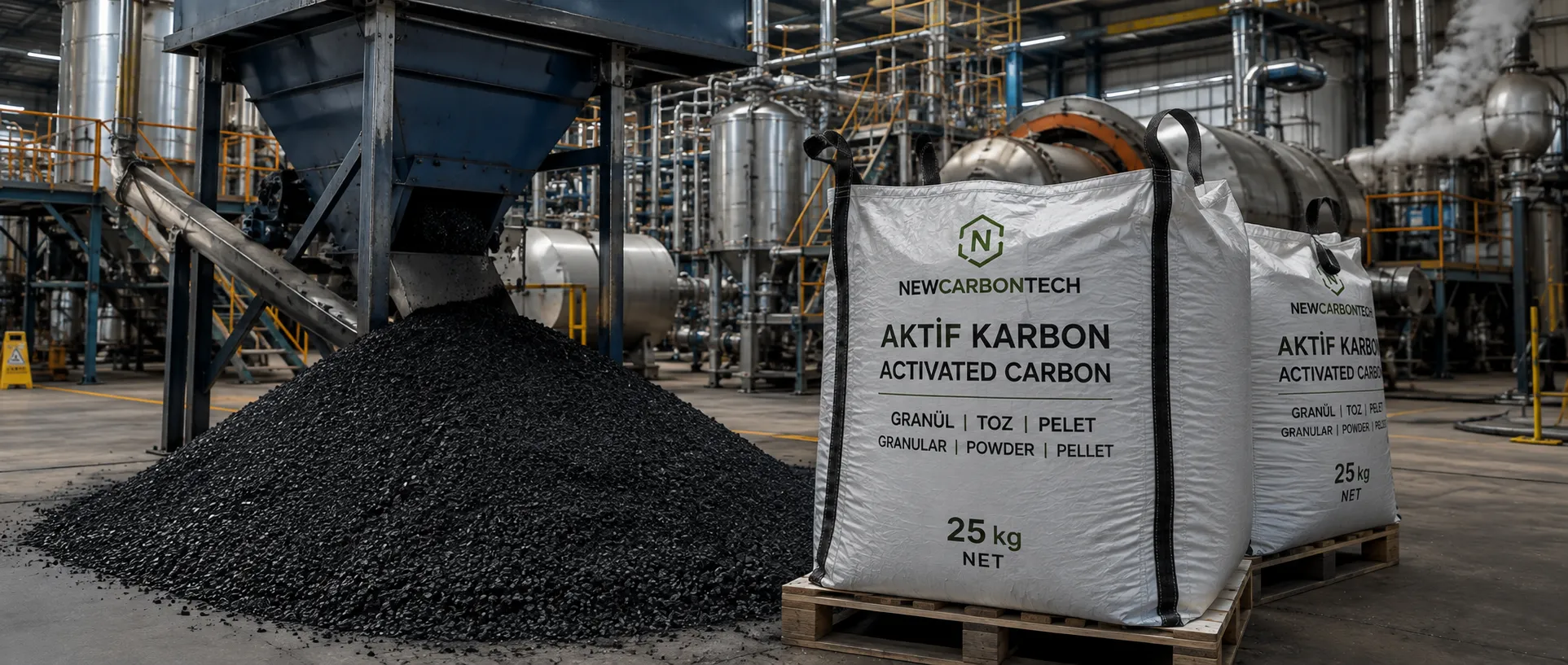
Granular Activated Carbon (GAC): Selection and Use Guide
Granular activated carbon (GAC) consists of irregular particles screened to 0.2–5 mm and is the most widely used form of activated carbon in industry. It works in fixed-bed systems with continuous flow: the fluid passes through the carbon bed, and contaminants stay behind in the pores.
What sets GAC apart from other forms?
Three core traits: continuity, low pressure drop and reusability. While powdered carbon is dosed once and discarded, granular carbon serves for months and can be thermally reactivated once saturated. In high-volume water treatment plants this cuts operating cost significantly.
How to choose the mesh range
Mesh describes the sieve size of the particles; the larger the number, the smaller the particle:
| Mesh | Particle size | Typical application |
|---|---|---|
| 6x12 | 1.7–3.4 mm | Gold recovery (CIL/CIP), gas phase |
| 8x30 | 0.6–2.4 mm | Municipal water treatment, general purpose |
| 12x40 | 0.4–1.7 mm | Drinking water, lines needing fast adsorption |
Smaller particles adsorb faster but increase pressure drop. The rule is simple: pick the finest mesh that still gives an acceptable pressure drop for your bed depth and flow rate. See our mesh selection article for details.
Which specifications matter?
- Iodine number (900–1100 mg/g): indicator of micropore capacity
- Hardness (above 95%): resistance to attrition and dust formation
- Ash content: lower ash means purer carbon and less mineral leaching
- Density: needed for bed design and fill calculations
Feedstock difference: coal or coconut?
Coal-based GAC is the general-purpose champion with its balanced pore distribution; coconut shell GAC stands out in drinking water and volatile organics thanks to its micropore-dominant structure and high hardness. We compare the two in detail in our feedstock comparison article.
To pin down the right granular carbon for your application, browse our granular product family — we produce mesh and specification to match your process.