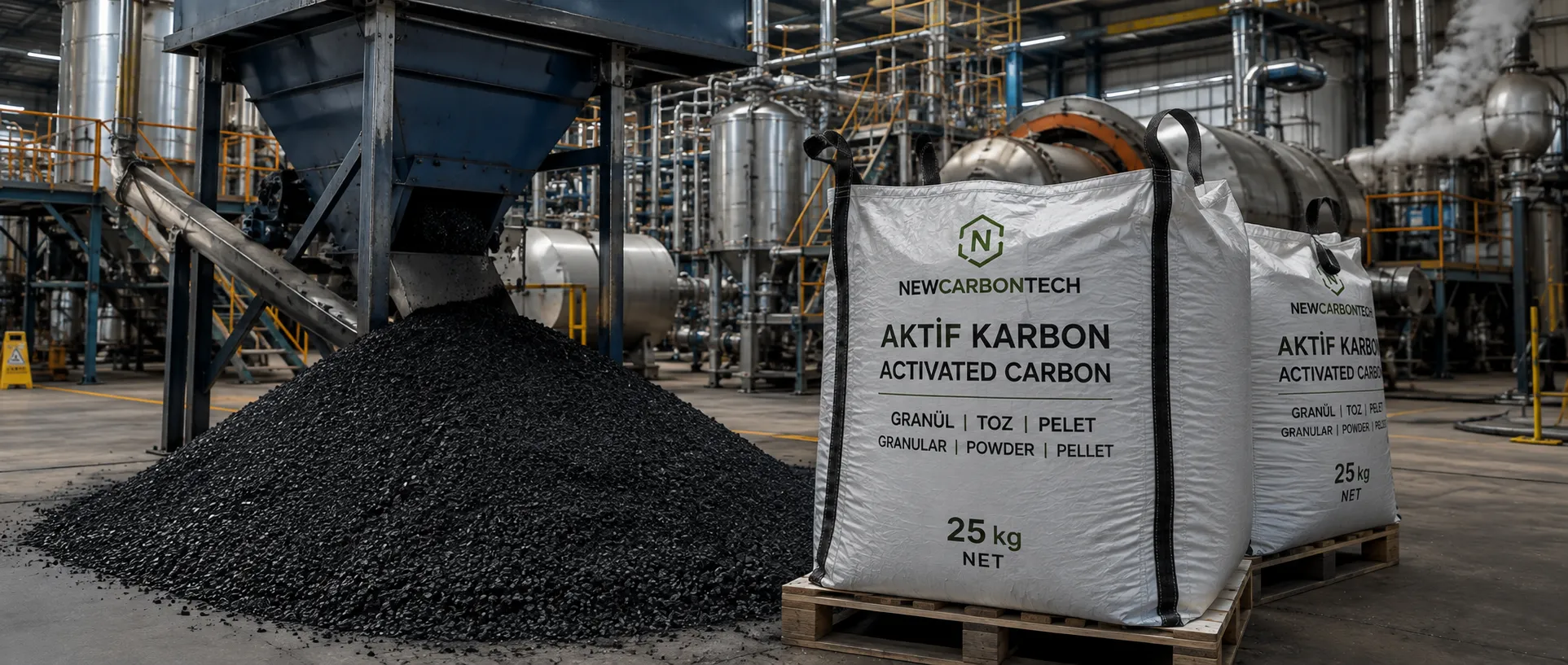
What Is Activated Carbon? A Complete Beginner's Guide
Activated carbon is a carbon material whose pores have been opened by controlled thermal treatment, packing 500 to 1500 square meters of internal surface into a single gram. That enormous surface consists of millions of micropores that physically capture contaminant molecules. It is the silent workhorse of countless industries, from water treatment to air purification, food to mining.
Adsorption: how activated carbon works
Activated carbon does not soak up contaminants — it holds them on its surface. The distinction matters: absorption is a sponge pulling water inside; adsorption is a molecule sticking to a surface. Contaminant molecules bind to the pore walls through van der Waals forces and are removed from the fluid stream.
Pore size is decisive in this process:
- Micropores (below 2 nm): small molecules — chlorine, volatile organics, odor compounds
- Mesopores (2–50 nm): mid-size molecules — color pigments, humic substances
- Macropores (above 50 nm): transport channels that carry molecules to the inner surface
How is it produced?
Production happens in two main steps. First, the raw material — coconut shell, coal or wood — is carbonized at 500–700°C in an oxygen-free atmosphere; volatiles are driven off, leaving a carbon skeleton. Then comes steam activation above 900°C: water vapor gasifies part of the carbon atoms, opening up the pore network. You can read more about our production process.
What forms does it come in?
| Form | Typical use |
|---|---|
| Granular (GAC) | Fixed-bed water filters, gold recovery |
| Powdered (PAC) | Dosed color and odor removal |
| Pellet | Air and gas lines, odor control |
| Impregnated | Targeted contaminants such as mercury and H2S |
Each form has its own strengths; the choice depends on the flow type of your application and the target contaminant. Our article GAC vs PAC is a good next step.
Where is it used?
Activated carbon is indispensable in drinking water plants for chlorine and organics removal, in industrial stacks for capturing volatile organic compounds, in sugar and oil refining for decolorization, in gold mines within cyanide leach circuits, and in pharmaceutical purification steps.
To pick the right carbon for your application, explore our product catalog or contact us directly — we respond with samples and data sheets.