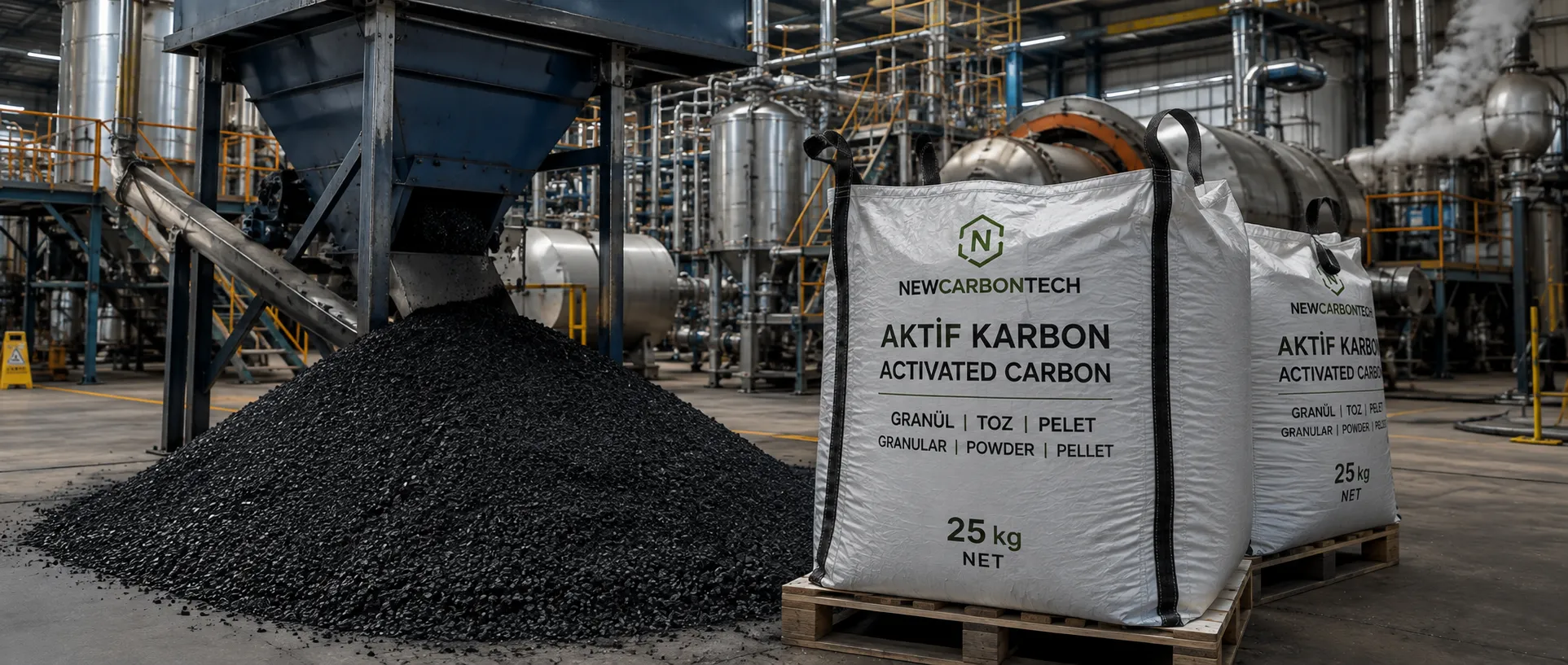
KOH-Impregnated Carbon: The Standard for H2S and Odor Control
That characteristic rotten-egg smell spreading around wastewater plants, pump stations and sewer networks is hydrogen sulfide (H2S). Its odor threshold is astonishingly low — the nose detects just a few molecules per billion — and at high concentration it is toxic. Industry’s standard answer to this problem: KOH-impregnated activated carbon.
Why plain carbon is not enough
H2S is a small, polar molecule; it clings weakly to standard carbon pores and passes through quickly. On potassium hydroxide loaded carbon, H2S is first neutralized on the alkaline surface, then oxidized to elemental sulfur and sulfate. The products stay trapped in the pores; the odor molecule is permanently destroyed.
Capacity in real numbers
The H2S capacity of KOH-impregnated carbon is expressed in grams per unit volume. Quality products deliver 0.14 g/cc and above — meaning one liter of carbon captures 140 grams of H2S. Standard carbon does not reach even a tenth of that; the price difference pays for itself in this arithmetic.
Typical applications
- Sludge building and headworks ventilation at wastewater plants
- Sewer pump station vents
- Biogas pre-cleaning — also consider the KI-impregnated alternative
- Process odors at food plants
Three golden rules of tower design
- Superficial velocity: keep within 0.3–0.5 m/s; fast gas exits before meeting the carbon
- Bed depth: minimum 0.5–1 meter; a thin bed leaks early
- Humidity management: 70–80 percent relative humidity is ideal; the oxidation reaction wants some moisture, but condensation drowns the pores
The preferred form is usually the 4 mm pellet: low pressure drop keeps fan costs under control.
If your facility is battling odor complaints, contact us — with your flow rate and H2S measurements we will size the tower fill together.